Mental toughness
Develop a more disciplined approach to pressure, focus and the challenges that test your resolve.
- Mental resilience
- Sustained focus under pressure

Personal Protection Awareness & Preparedness
Build the mindset to recognize risk, strengthen your self-control and prepare for the moments that matter.
The Certificate of Practical Achievement is earned by completing the online course and passing the practical stage. Online study alone does not qualify.
For people who want to take a more active role in their own safety. Begin with the person behind every decision: you.
Develop a more disciplined approach to pressure, focus and the challenges that test your resolve.
Explore how self-awareness and self-control support a more confident, prepared response.
Strengthen your awareness of personal security and turn the intention to prepare into practical habits.
ISA connects academic understanding, practical experience and continuous professional development. Explore the ideas that shape the academy’s approach—from personal preparedness through to specialist protection and security leadership.
One academy. Distinct learning pathways. HISHUL develops personal awareness and preparedness. The wider professional programmes have their own curricula, entry requirements and assessments.
Security and safety influence the conditions in which people live, organisations operate and economies develop. ISA’s integrated study platform is built around the need to understand this wider environment, then prepare people to act with greater awareness and professional responsibility.
International conflicts, including those in Ukraine and Israel, economic uncertainty and changing patterns of crime form part of the context in which security decisions are made. Their consequences vary by location. Preparation begins with understanding the actual environment and its risks, rather than assuming yesterday’s experience will answer tomorrow’s challenges.
Economic pressure encourages organisations and entrepreneurs to explore new markets and opportunities overseas. Entering an unfamiliar environment also means encountering different security conditions, local practices and protection needs. A lack of awareness and appropriate preparation can expose people, disrupt operations and hold back business development.
These concerns extend across Africa, the Middle East, Asia, the CIS, Latin America and Europe. Local knowledge matters. Residents, visiting investors, specialists and organisations all depend on security arrangements that fit the circumstances in which they live and work.
A central message for the civilian population is clear: be more aware and better prepared for violent crime, emergencies, modern catastrophes and terrorist incidents. Public empowerment and personal preparedness form part of that wider responsibility.
ISA’s philosophy recognises the contribution of civilian security organisations alongside public authorities. Depending on the country and the assignment, this may involve protecting assets, guarding sensitive locations, supporting access restrictions, preventing crime and protecting people exposed to particular risks. Roles, powers and responsibilities must be understood within the applicable local framework.
As organisations entrust more responsibilities to security providers, the demand for effective preparation grows. Practitioners need more than familiarity with equipment or a record of previous service. Military, police and operational experience can provide a valuable foundation; new roles still require current knowledge, suitable professional preparation and an understanding of the responsibilities involved.
Regulatory requirements, organisational expectations and security conditions can change. Continuing study helps practitioners examine those changes, recognise the limits of their existing preparation and identify where further training is required.
Protection consultants, advisers, specialists and leaders must connect their knowledge to the real needs of the people and organisations they serve. ISA’s broader professional pathways aim to support that development, including the transition of experienced military, law-enforcement and private-security personnel into civilian security responsibilities.
The purpose is preparation that supports people, organisations and responsible professional practice. Career development is a reason to study; it depends on demonstrated competence, the requirements of the role and the conditions of the market.
Security is a strategic responsibility that affects continuity, reputation and human life. Across organisations, critical infrastructure and international operations, effective security leadership depends on people who can connect practical experience with structured judgement.
The role of a Chief Security Officer extends beyond guarding assets or reacting to incidents. It involves anticipating risk, identifying vulnerabilities before they become crises, and protecting an organisation across its physical, human, operational and reputational dimensions—often under pressure and with real consequences.
Responsibility can grow faster than preparation. Professionals may move into leadership through operational or tactical experience without a structured framework connecting risk assessment, leadership, crisis management, asset protection and executive decision-making. The gap can expose both the organisation and the person carrying that responsibility.
The professional programmes address the preparation of professionals responsible for sensitive installations, critical assets, VIPs, specialists, journalists, humanitarian personnel, maritime crews and multinational operations. The environment and assignment may change; the need for disciplined preparation remains.
A security leader must identify weak points, design coordinated protection arrangements, work with stakeholders, manage crises and make decisions with human and organisational consequences. These abilities require study, practice, testing and refinement.
ISA’s Security & Protection Management Specialization is part of the academy’s response to that need. It is intended for people who understand that professional development continues throughout a career, and who are prepared to strengthen their knowledge, structure and responsibility as their roles evolve.
“There is no finish line in security—only continuous advancement.”
For HISHUL participants, that philosophy starts at the personal level: develop awareness, self-control and preparedness, then put the learning into practice. The specialist management and protection programmes extend the approach into professional responsibilities through their own curricula.
Readiness must be developed, tested and refined. The value of a programme lies in what the participant understands and can demonstrate.
Academic understanding and practical relevance belong together. ISA’s integrated approach connects theoretical study with the experience of applying knowledge in realistic circumstances. The intention is to help participants understand both the reasoning behind a decision and the responsibilities involved in carrying it out.
The broader security-management and leadership programmes draw on several disciplines. Security studies and political science provide context; psychology, sociology and criminology help examine human behaviour and patterns of offending; law, economics, history and anthropology broaden the understanding of institutions, communities and the consequences of decisions.
These perspectives matter when examining why security problems develop, how they affect the public and organisations, and how protective decisions influence the environment in which people live and work. A practical measure is stronger when its purpose, limitations and consequences are understood.
The curriculum philosophy combines a foundation in core security issues with opportunities to develop professional interests. These include intelligence and defence analysis, international security, crime prevention, counter-terrorism and public empowerment. The relevant subjects and depth of study depend on the programme selected.
ISA’s approach draws on Israeli and international security experience and the perspectives of scholars and practitioners. It connects classroom study with the real-world issues faced by security executives, commanders, operational personnel and leaders.
The broader mission is to support the development of security executives, analysts, advisers and other practitioners who can examine complex situations, connect different sources of knowledge and take responsibility for informed decisions.
Distance learning and self-study provide flexibility to study alongside personal and professional commitments. Reviewing the material, testing understanding and returning to difficult subjects are part of the learning process. The language tools make the written learning material more accessible to an international audience.
Practical completion sessions, exercises and workshops add the opportunity to apply relevant learning, receive guidance and examine performance. The format and requirements depend on the chosen pathway.
Within HISHUL, the three online modules establish the foundation in mental toughness, self-awareness, self-control and personal protection. The practical stage takes that preparation into supervised training and assessment.
The connection between study and experience is central to the programme. Knowledge should inform conduct; practice should reveal what needs further work.
ISA presents development as an integrated qualification journey: strengthening knowledge, improving judgement and preparing participants to carry greater responsibility. Its wider professional programmes address security, protection, management and leadership.
The professional audience includes current and aspiring protection operatives, directors, managers, commanders, specialists and consultants working in:
The specialist programmes examine violent crime, terrorism and protective responses through structured questions: Who presents the threat? How do offenders operate and gather information? What patterns and methods appear in relevant cases? Which protective measures can reduce exposure?
Participants encounter Israeli protection concepts, methods, techniques and security technologies within the curriculum of their selected programme. The aim is to connect those subjects with the design and implementation of integrated protection plans.
Doctrine, people, technology and procedures must work together. Planning, leading, commanding and operating a protection arrangement require an understanding of how those elements support one another.
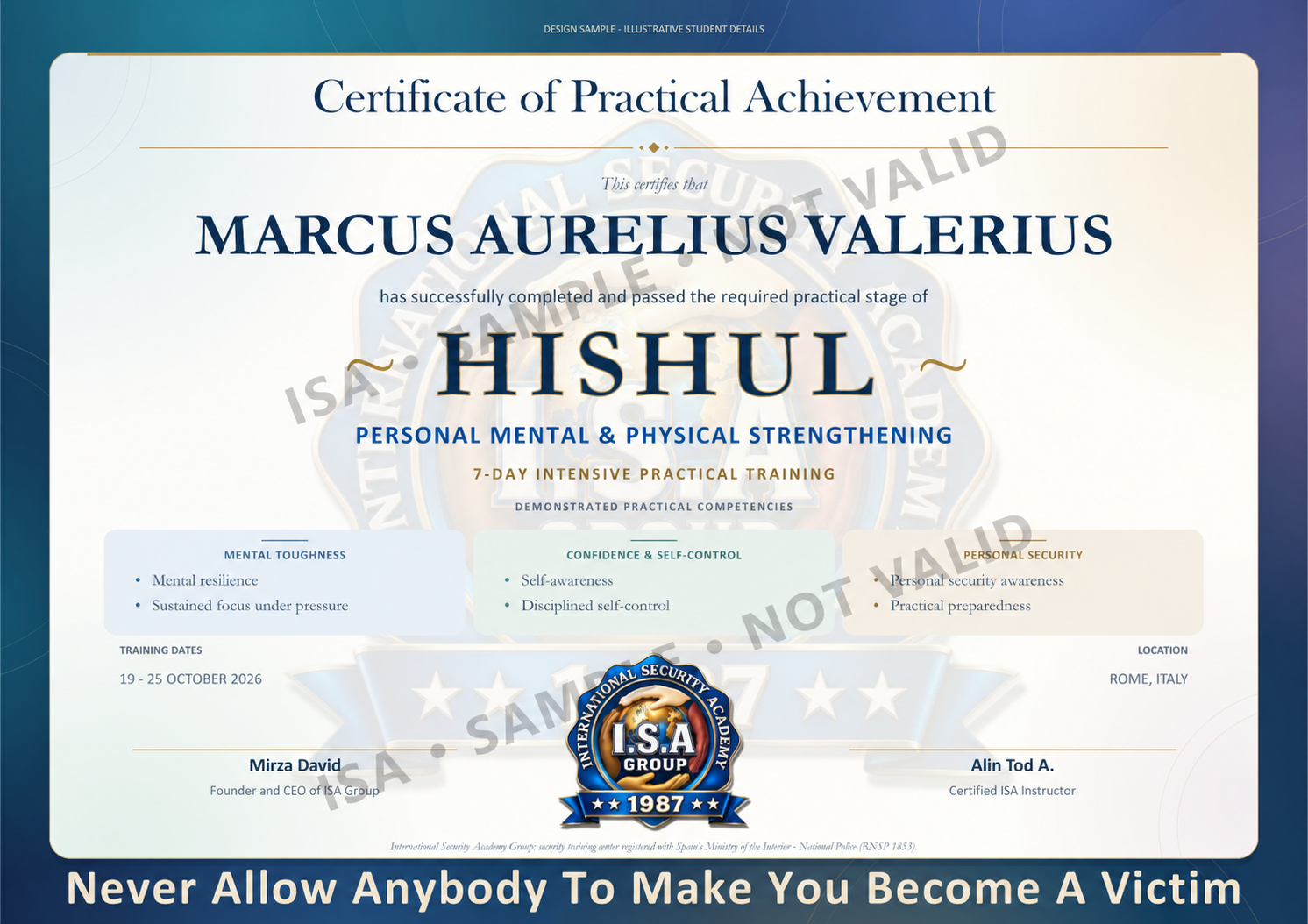
HISHUL has its own personal-development focus: mental resilience and sustained focus, self-awareness and disciplined self-control, personal-security awareness and practical preparedness. These are the competencies reflected in the Certificate of Practical Achievement shown on this page.
The advanced professional subjects described here belong to their respective programmes. They provide context for ISA’s wider educational philosophy and a route for further development.
Study is an active process. The study platform describes a sequence of completing the learning modules, reviewing understanding through self-examination and completing the assessments required by the chosen programme.
Participants should work through the full curriculum of the programme in which they are enrolled. The purpose of self-assessment is to identify gaps in understanding and return to the material before progressing. Final online assessments and completion requirements are determined by the relevant course.
The study platform distinguishes distance study from practical completion. Students build the necessary knowledge through online learning before joining the relevant practical training and assessments, subject to that programme’s admission arrangements.
For the certificate presented on this landing page, the required route is explicit: complete the online Personal Protection Awareness & Preparedness course and pass the required practical stage. Completing online study alone does not qualify for this certificate.
Contact ISA to confirm admission requirements, practical-stage dates, location, availability, fees and assessment arrangements. The current offer of 30 days of free online access applies to the online course; practical training is arranged separately.
The study platform describes the Security & Protection Bible as a personal study resource and a foundation for continuing professional development. Its broader protection programmes aim to help participants connect knowledge with operational judgement and teamwork.
The following subjects describe the wider professional pathways. The curriculum, training opportunities and assessment requirements depend on the selected programme; they are not all included in the three-module HISHUL online foundation.
The ambition is continued improvement in knowledge, judgement, expertise and professional standing. Progress depends on the participant’s preparation, practice and demonstrated performance.
Use the study material. Question what you do not understand. Prepare, practise and keep developing.
Choose the pathway that matches your preparation and responsibilities.
Discuss your study pathway with ISAStart the Personal Protection Awareness & Preparedness course and complete its online learning. The current introductory offer provides 30 days of free online access.
View the course and curriculum →Continue with “HISHUL” – Personal mental & physical strengthening: seven days of intensive practical training. Demonstrate the required competencies and pass the practical assessment to earn the certificate.
Contact UsPlan your next step with ISA. Contact the academy to confirm practical-stage dates, location, availability, eligibility and fees. The free online offer does not include practical training or guarantee a certificate.
Your certificate records the effort you put into training and the competencies you demonstrate. It follows both the online foundation and a successful practical assessment.

TO BE CONSIDERED
THE BESTYOU SHOULD TRAIN AMONGST
THE BEST !Looking for specialist professional training? Explore these distinct programmes. They are not requirements for the HISHUL Certificate of Practical Achievement.

Explore ISA’s professional protection pathway and its dedicated course curriculum.
Телохранител • Protection rapprochée • Escolta privado • Gardă Personală • Σωματοφύλακας • 要员保护 • Guarda-costas • Ochroniarz • Бодигард • Telohranitelj • Guardia del corpo • Personenschutz • حارس شخصي

Advanced academic and practical training for security and protection practitioners.
BUILD LEADERSHIP. STRENGTHEN OPERATIONS. COMMAND WITH CONFIDENCE.
Security professionals • Law enforcement • Investigators • Intelligence units • Industrial facilities • Security agencies
Know what is included, what comes next, and what it takes to earn the certificate.
No. You must complete the online Personal Protection Awareness & Preparedness course and then pass the required practical stage. Online completion alone does not qualify for the Certificate of Practical Achievement.
The current course listing offers 30 days of free online access to the introductory course. Practical training is a separate stage. Ask ISA to confirm its fees, dates, location and admission arrangements before making plans.
The programme addresses personal awareness, confidence and preparedness for youth, women and men. Contact ISA to confirm suitability and age requirements for the practical stage.
Contact ISA to discuss the seven-day HISHUL practical stage, its entry requirements, available dates, location and fees. A place and a certificate are not automatically included when you begin the online course.
Use the language selector in the bottom-right corner. The course information and banners can be translated. The certificate remains an English image to preserve its original design and proportions.
Open the student learning system and sign in to continue your enrolled courses.
Start with the three online modules. Then speak with ISA about putting your learning into practice and earning your Certificate of Practical Achievement.
30 days of free online access. Practical training and assessment arranged separately.